Hallucinations can hurt your business
What Every CEO Needs to Know About AI's Hidden Risk
You've invested in AI. Your team is using it. The outputs look polished, authoritative, and ready to act on. But there's a problem lurking beneath the surface that could quietly be steering your business decisions in the wrong direction — and it has a name: AI hallucinations.
No, your AI tool isn't daydreaming. Hallucinations, in the AI world, refer to moments when a system generates information that sounds completely credible but is, in fact, entirely made up. The model doesn't flag it as uncertain. It doesn't hesitate. It delivers fiction with the same confident tone it uses for facts — and that confidence is exactly what makes it so dangerous.
If you're a CEO or CMO using AI to shape marketing strategies, competitive analyses, or business decisions, understanding AI hallucination risks for executives is no longer optional. The good news? You don't need to be a data scientist to handle it. You just need the right workflow and mindset.
"People have a very high degree of trust in ChatGPT, which is interesting, because AI hallucinates. It should be the tech that you don't trust that much." — Sam Altman, CEO of OpenAI
That quote from the person who built ChatGPT should stop you in your tracks. If even the creator of the world's most widely used AI tool is urging caution, that's a signal worth heeding.
The Business Stakes Are Real
This isn't a theoretical problem. The financial and reputational risks of unchecked AI hallucinations are significant — and growing.
A Deloitte surveyfound that 38% of enterprise AI users made at least one major business decision based on hallucinated content in 2024. Global financial losses tied to AI hallucinations reached $67.4 billion that same year.
A 2024 Stanford study found that when asked legal questions, AI models hallucinated at least 75% of the time about court rulings. For CMOs relying on AI to research competitor positioning, industry regulations, or consumer data trends, that error rate should be a flashing red light.
"Enterprise AI Cost Analysis 2025." Knowledge workers spend an average of 4.3 hours per week verifying AI outputs, at an estimated cost of $14,200 per employee per year. Reported by Four Dots for Forrester Research,
The takeaway isn't that AI is too risky to use. Quite the opposite. But it doesmean that using AI without an AI verification framework is like driving without a seatbelt — fine until it isn't.
So how do you overcome hallucinations in your business?
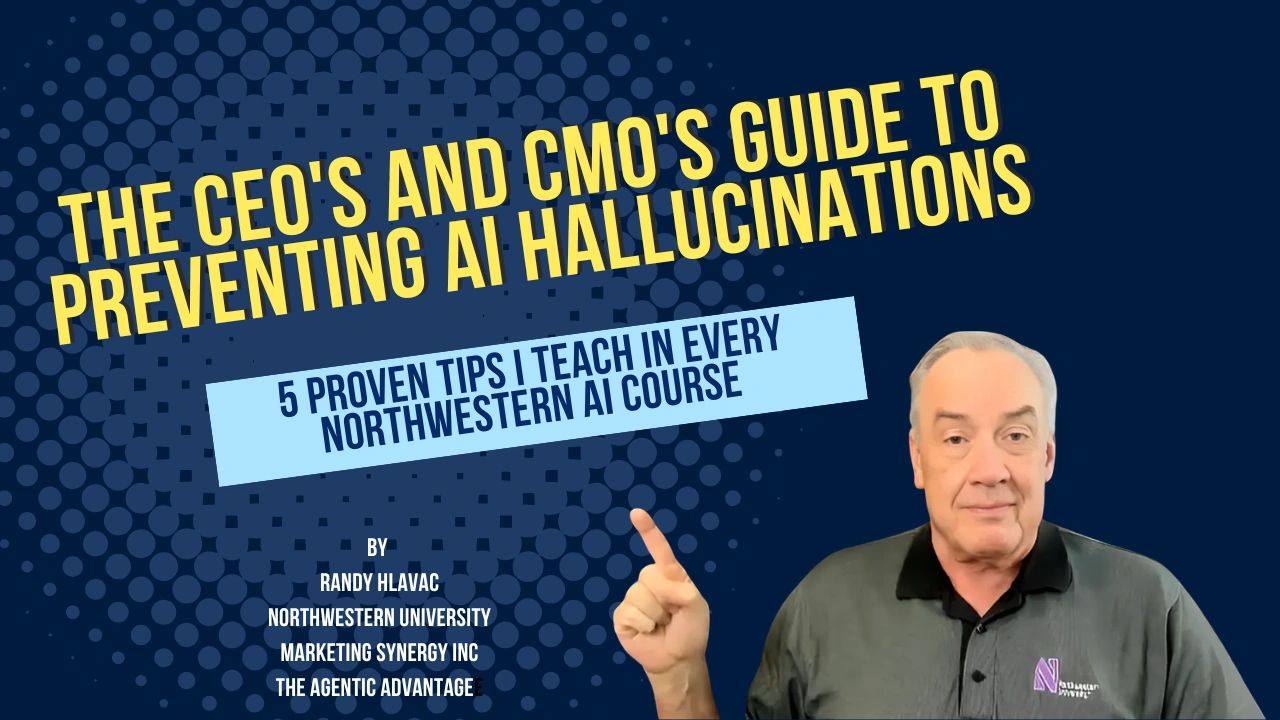
The following are 5 proven ways to help avoid hallucinations. In my graduate and undergraduate courses at Northwestern University, I mandate the students use the first 3 in every one of the AI assignments. I tell them to remember AI is like a little child. They are desperate to give you an answer…even if they have to make one up. You need to check and verity the answers are correct. Accuracy and authenticity is critical to growing your business…and the Ais are checking your content.
Tip #1: Interrogate the AI's Confidence Levels
A couple of points. I like to use confidence intervals because it gives me insights into where the AI is producing less than solid facts, studies and quotes. In using some Ais like Claude and Perplexity, they will ask me if I want to get other more solid studies and quotes. Say ‘yes’ then determine the ones you want to include. Second, be sure to do this check just before you publish. Copy/paste your final article or script into one of the Ais and do this check. Things change, and there may be newer information you might want to include. Finally, I just put the 0 – 100% prompt into my initial prompt string so the AI automatically determines the strength of its citations. When I originally wrote this blog, 2 of the 3 citations needed significant adjustments to be citable.
Here's a counterintuitive insight about generative AI risks: AI models often use more confident language when they're wrong than when they're right. The system doesn't signal uncertainty the way a human expert would — it delivers guesses with the same assertive tone as established facts.
You can disrupt this pattern by explicitly asking the AI to rate its own confidence. After receiving any substantive output, follow up with a prompt like:
"On a scale from 0–100%, how confident are you in each of the claims you just made?" "Which parts of this response are you less certain about?" "If you don't know something with confidence, please say so."
A practical confidence framework to use:
Confidence Level Interpretation
95% or above – Virtually certain — proceed with reasonable trust
80–95% – Highly confident — worth verifying for high-stakes decisions
60–80% – Moderate — treat as a starting point, not a final answer
40–60% – Speculative — do not use without independent verification
Below 40% – Low confidence — discard or heavily research before use
When you ask the AI to explain why it chose a particular confidence level, something valuable happens: it often backtracks on weak claims it initially stated with authority. That reversal is exactly the kind of signal you need to protect your decisions.
"Prompt injections, hallucinations, and unauthorized tool usage aren't theoretical risks anymore. To have successful and secure AI deployments, trust and governance need to be embedded directly into agent decision loops, not bolted on afterward."— AI Security Expert, Solutions Review (2025)
Tip #2: Get a Second Opinion from Another AI
This is my most critical tip. Ais are trained using different data sets [LLMs]. The result is they have different sources of information and are in varying degrees of updates. When your team finishes an article, copy/paste the article and take it to another AI, input the article and then ask it to verify your studies and quotes. Also, ask it if there are more recent ones to consider. At Marketing Synergy and The Agentic Advantage, we call that cascading your Ais to ensure accuracy. Do this every time you are getting ready to publish. Things change quickly in business.
Different AI models hallucinate in different places. No single model has the same blind spots as every other, which means cross-model AI verification is one of your most effective defenses against accepting bad information — and one of the smartest best practices for using AI in marketing strategy.
The workflow is simple: take a substantive response from one model — say, ChatGPT — and paste it into a different model such as Claude, Perplexity or Gemini. Then ask:
"Critique this response. What's missing? What's potentially incorrect? Where might there be unsupported assumptions or bias?"
More conservative models, in particular, are often good at flagging speculative or unsupported points that other models present as established fact. This "second opinion" approach mirrors what journalists call two-source verification — a standard that exists precisely because single-source information is unreliable.
"The same way journalists use two-source verification, AI users should use multi-model verification. The human must maintain editorial judgment. AI produces answers; you confirm their truth." — Principle advocated by leading AI productivity educators
Tip #3: Educate Your AI Before You Use It
When you educate an AI, it learns about your company and your project. In every one of my AI assignments at Northwestern, we always start with a prompt this prompt :Here is information on my company [company name] located at [website address] In addition, if there are relevant studies, white papers, etc relevant to the project, we add them as well. If you have a team of content developers, starting with training is critical because it gives you a consistent voice and a solid knowledge of your products and services.
One of the most common mistakes executives make is jumping straight into prompts without first establishing a knowledge foundation. Think of your AI session like a new employee's first day. You wouldn't hand a brand-new hire a complex strategic assignment before they knew anything about your company, your customers, or your goals.
The same principle applies when considering best practices for using AI in marketing strategy. Before you begin any analysis, competitive review, or content creation task, brief your AI with the context it needs:
Your company's mission and positioning Your target audiences and customer personas Your key differentiators and competitive advantages The specific business problem you're trying to solve
The more precisely you educate the AI upfront, the better your AI accuracy will be. Skipping this step is one of the most reliable ways to invite hallucinations.
Tip #4: Use Control Questions to Validate the AI's Understanding
Often, I will use control questions to verify the AI understands my company and my project. I have written one book but, after I educate it on my company, I ask the AI how many books has Randy Hlavac written? More than once, I get answers like 2 or 3. In checking them, I find they attempted to match people with names spelled like mine or near the topic of my book. When that happens I correct the AI then ask more control questions. If the AI misunderstands you or your project, it will give you bad answers. GIGO
This is one of the most underutilized tools in the executive AI toolkit, and it's remarkably simple. Control questions are a set of predefined, factual queries you ask the AI at the start of every session to verify that it understands your business correctly before you trust it with anything more complex. They are a foundational part of how to verify AI-generated content for accuracy.
Think of them as a sanity check. If the AI gets these baseline questions wrong, anything it produces in that session should be treated with serious skepticism.
Effective control questions for business and marketing use might include:
"What is the mission of our company?" "Who are the primary target audiences for our products or services?" "What industries or sectors do we specialize in?" "What makes our offerings unique compared to competitors?"
If the AI's answers don't align with your actual company positioning, stop. Correct it, restate the accurate information, and re-ask until the responses reflect reality. Only then should you proceed to your actual analysis or content tasks.
This approach is especially critical when you're running multiple AI sessions to examine different aspects of the same business. You want the AI looking at your organization through the same "lens" each time — with consistent, accurate baseline understanding.
Tip #5: Structure Your Prompts with Precision
If you want to really improve your AI results, start each prompt by telling the AI the role you want it assume. Example: “You are an expert in identifying AI hallucinations and the adverse impact they can have on a business”. By telling the AI its role, it can then better focus on giving you the results you desire. Then make the prompt very specific.
Vague prompts are an open invitation for AI hallucinations. The less context and specificity you provide, the more the AI will fill the gaps with assumptions — and those assumptions may have nothing to do with your actual business. Knowing how to write better AI prompts to reduce errors is one of the highest-leverage skills a CEO or CMO can develop right now.
Compare these two prompts:
❌ Weak: "What are our target audiences?" ✅ Strong: "Based on our services in B2B digital marketing for mid-market manufacturers, who are the most likely target audiences for our lead generation campaigns, and what are their primary pain points?"
The stronger version gives the AI parameters to work within. It knows the industry, the company's service category, and the specific use case. The result will be far more accurate and actionable — a direct improvement in AI accuracy that requires no technical expertise whatsoever.
AI prompt tips and best practices for prompt construction:
Always tell the AI the role you want it to play Always provide industry context and company category Specify the purpose of the output (analysis, content creation, audience research) Reference specific documents, data, or source materials when available Ask for reasoning alongside conclusions — not just answers Request that the AI flag any areas where it has limited information
The Bottom Line: Trust AI, But Verify Everything That Matters
AI is not going away. If anything, the rate of improvement is accelerating, with some models reporting up to a 64% drop in hallucination rates in 2025. The tools are getting better. But "getting better" is not the same as "fully reliable" — and for CEOs and CMOs making decisions that affect brand, revenue, and reputation, "mostly right" isn't good enough.
The executives who will get the most value from AI are not those who use it the most — they're those who use it the smartest. Learning how to prevent AI hallucinations in business isn't about fear; it's about maintaining the editorial judgment and strategic control that effective leadership demands.
Think of it this way: you wouldn't act on a market research report without checking the methodology. You wouldn't publish a press release without a legal review. Extend that same discipline to your AI outputs, and you'll unlock the genuine strategic advantage these tools offer — without the costly mistakes that come from taking them at face value.
AI hallucinations are a known, manageable risk. With the right habits in place, they don't have to derail your strategy.