Category: Uncategorized

  • CEO’s Guide to Preventing AI Hallucinations

    Hallucinations will hurt your business

    Hallucinations can hurt your business

    What Every CEO Needs to Know About AI's Hidden Risk

    You've invested in AI. Your team is using it. The outputs look polished, authoritative, and ready to act on. But there's a problem lurking beneath the surface that could quietly be steering your business decisions in the wrong direction — and it has a name: AI hallucinations.

    No, your AI tool isn't daydreaming. Hallucinations, in the AI world, refer to moments when a system generates information that sounds completely credible but is, in fact, entirely made up. The model doesn't flag it as uncertain. It doesn't hesitate. It delivers fiction with the same confident tone it uses for facts — and that confidence is exactly what makes it so dangerous.

    If you're a CEO or CMO using AI to shape marketing strategies, competitive analyses, or business decisions, understanding AI hallucination risks for executives is no longer optional. The good news? You don't need to be a data scientist to handle it. You just need the right workflow and mindset.

    "People have a very high degree of trust in ChatGPT, which is interesting, because AI hallucinates. It should be the tech that you don't trust that much." — Sam Altman, CEO of OpenAI

    That quote from the person who built ChatGPT should stop you in your tracks. If even the creator of the world's most widely used AI tool is urging caution, that's a signal worth heeding.

    The Business Stakes Are Real

    This isn't a theoretical problem. The financial and reputational risks of unchecked AI hallucinations are significant — and growing.

    A Deloitte surveyfound that 38% of enterprise AI users made at least one major business decision based on hallucinated content in 2024. Global financial losses tied to AI hallucinations reached $67.4 billion that same year.

    A 2024 Stanford study found that when asked legal questions, AI models hallucinated at least 75% of the time about court rulings. For CMOs relying on AI to research competitor positioning, industry regulations, or consumer data trends, that error rate should be a flashing red light.

    "Enterprise AI Cost Analysis 2025." Knowledge workers spend an average of 4.3 hours per week verifying AI outputs, at an estimated cost of $14,200 per employee per year. Reported by Four Dots for Forrester Research,

    The takeaway isn't that AI is too risky to use. Quite the opposite. But it doesmean that using AI without an AI verification framework is like driving without a seatbelt — fine until it isn't.

    So how do you overcome hallucinations in your business?

    The following are 5 proven ways to help avoid hallucinations. In my graduate and undergraduate courses at Northwestern University, I mandate the students use the first 3 in every one of the AI assignments. I tell them to remember AI is like a little child. They are desperate to give you an answer…even if they have to make one up. You need to check and verity the answers are correct. Accuracy and authenticity is critical to growing your business…and the Ais are checking your content.

    Tip #1: Interrogate the AI's Confidence Levels

    A couple of points. I like to use confidence intervals because it gives me insights into where the AI is producing less than solid facts, studies and quotes. In using some Ais like Claude and Perplexity, they will ask me if I want to get other more solid studies and quotes. Say ‘yes’ then determine the ones you want to include. Second, be sure to do this check just before you publish. Copy/paste your final article or script into one of the Ais and do this check. Things change, and there may be newer information you might want to include. Finally, I just put the 0 – 100% prompt into my initial prompt string so the AI automatically determines the strength of its citations. When I originally wrote this blog, 2 of the 3 citations needed significant adjustments to be citable.

    Here's a counterintuitive insight about generative AI risks: AI models often use more confident language when they're wrong than when they're right. The system doesn't signal uncertainty the way a human expert would — it delivers guesses with the same assertive tone as established facts.

    You can disrupt this pattern by explicitly asking the AI to rate its own confidence. After receiving any substantive output, follow up with a prompt like:

    "On a scale from 0–100%, how confident are you in each of the claims you just made?" "Which parts of this response are you less certain about?" "If you don't know something with confidence, please say so."

    A practical confidence framework to use:

    Confidence Level Interpretation

    95% or above – Virtually certain — proceed with reasonable trust

    80–95% – Highly confident — worth verifying for high-stakes decisions

    60–80% – Moderate — treat as a starting point, not a final answer

    40–60% – Speculative — do not use without independent verification

    Below 40% – Low confidence — discard or heavily research before use

    When you ask the AI to explain why it chose a particular confidence level, something valuable happens: it often backtracks on weak claims it initially stated with authority. That reversal is exactly the kind of signal you need to protect your decisions.

    "Prompt injections, hallucinations, and unauthorized tool usage aren't theoretical risks anymore. To have successful and secure AI deployments, trust and governance need to be embedded directly into agent decision loops, not bolted on afterward."— AI Security Expert, Solutions Review (2025)

    Tip #2: Get a Second Opinion from Another AI

    This is my most critical tip. Ais are trained using different data sets [LLMs]. The result is they have different sources of information and are in varying degrees of updates. When your team finishes an article, copy/paste the article and take it to another AI, input the article and then ask it to verify your studies and quotes. Also, ask it if there are more recent ones to consider. At Marketing Synergy and The Agentic Advantage, we call that cascading your Ais to ensure accuracy. Do this every time you are getting ready to publish. Things change quickly in business.

    Different AI models hallucinate in different places. No single model has the same blind spots as every other, which means cross-model AI verification is one of your most effective defenses against accepting bad information — and one of the smartest best practices for using AI in marketing strategy.

    The workflow is simple: take a substantive response from one model — say, ChatGPT — and paste it into a different model such as Claude, Perplexity or Gemini. Then ask:

    "Critique this response. What's missing? What's potentially incorrect? Where might there be unsupported assumptions or bias?"

    More conservative models, in particular, are often good at flagging speculative or unsupported points that other models present as established fact. This "second opinion" approach mirrors what journalists call two-source verification — a standard that exists precisely because single-source information is unreliable.

    "The same way journalists use two-source verification, AI users should use multi-model verification. The human must maintain editorial judgment. AI produces answers; you confirm their truth." — Principle advocated by leading AI productivity educators

    Tip #3: Educate Your AI Before You Use It

    When you educate an AI, it learns about your company and your project. In every one of my AI assignments at Northwestern, we always start with a prompt this prompt :Here is information on my company [company name] located at [website address] In addition, if there are relevant studies, white papers, etc relevant to the project, we add them as well. If you have a team of content developers, starting with training is critical because it gives you a consistent voice and a solid knowledge of your products and services.

    One of the most common mistakes executives make is jumping straight into prompts without first establishing a knowledge foundation. Think of your AI session like a new employee's first day. You wouldn't hand a brand-new hire a complex strategic assignment before they knew anything about your company, your customers, or your goals.

    The same principle applies when considering best practices for using AI in marketing strategy. Before you begin any analysis, competitive review, or content creation task, brief your AI with the context it needs:

    Your company's mission and positioning Your target audiences and customer personas Your key differentiators and competitive advantages The specific business problem you're trying to solve

    The more precisely you educate the AI upfront, the better your AI accuracy will be. Skipping this step is one of the most reliable ways to invite hallucinations.

    Tip #4: Use Control Questions to Validate the AI's Understanding

    Often, I will use control questions to verify the AI understands my company and my project. I have written one book but, after I educate it on my company, I ask the AI how many books has Randy Hlavac written? More than once, I get answers like 2 or 3. In checking them, I find they attempted to match people with names spelled like mine or near the topic of my book. When that happens I correct the AI then ask more control questions. If the AI misunderstands you or your project, it will give you bad answers. GIGO

    This is one of the most underutilized tools in the executive AI toolkit, and it's remarkably simple. Control questions are a set of predefined, factual queries you ask the AI at the start of every session to verify that it understands your business correctly before you trust it with anything more complex. They are a foundational part of how to verify AI-generated content for accuracy.

    Think of them as a sanity check. If the AI gets these baseline questions wrong, anything it produces in that session should be treated with serious skepticism.

    Effective control questions for business and marketing use might include:

    "What is the mission of our company?" "Who are the primary target audiences for our products or services?" "What industries or sectors do we specialize in?" "What makes our offerings unique compared to competitors?"

    If the AI's answers don't align with your actual company positioning, stop. Correct it, restate the accurate information, and re-ask until the responses reflect reality. Only then should you proceed to your actual analysis or content tasks.

    This approach is especially critical when you're running multiple AI sessions to examine different aspects of the same business. You want the AI looking at your organization through the same "lens" each time — with consistent, accurate baseline understanding.

    Tip #5: Structure Your Prompts with Precision

    If you want to really improve your AI results, start each prompt by telling the AI the role you want it assume. Example: “You are an expert in identifying AI hallucinations and the adverse impact they can have on a business”. By telling the AI its role, it can then better focus on giving you the results you desire. Then make the prompt very specific.

    Vague prompts are an open invitation for AI hallucinations. The less context and specificity you provide, the more the AI will fill the gaps with assumptions — and those assumptions may have nothing to do with your actual business. Knowing how to write better AI prompts to reduce errors is one of the highest-leverage skills a CEO or CMO can develop right now.

    Compare these two prompts:

    ❌ Weak: "What are our target audiences?" ✅ Strong: "Based on our services in B2B digital marketing for mid-market manufacturers, who are the most likely target audiences for our lead generation campaigns, and what are their primary pain points?"

    The stronger version gives the AI parameters to work within. It knows the industry, the company's service category, and the specific use case. The result will be far more accurate and actionable — a direct improvement in AI accuracy that requires no technical expertise whatsoever.

    AI prompt tips and best practices for prompt construction:

    Always tell the AI the role you want it to play Always provide industry context and company category Specify the purpose of the output (analysis, content creation, audience research) Reference specific documents, data, or source materials when available Ask for reasoning alongside conclusions — not just answers Request that the AI flag any areas where it has limited information

    The Bottom Line: Trust AI, But Verify Everything That Matters

    AI is not going away. If anything, the rate of improvement is accelerating, with some models reporting up to a 64% drop in hallucination rates in 2025. The tools are getting better. But "getting better" is not the same as "fully reliable" — and for CEOs and CMOs making decisions that affect brand, revenue, and reputation, "mostly right" isn't good enough.

    The executives who will get the most value from AI are not those who use it the most — they're those who use it the smartest. Learning how to prevent AI hallucinations in business isn't about fear; it's about maintaining the editorial judgment and strategic control that effective leadership demands.

    Think of it this way: you wouldn't act on a market research report without checking the methodology. You wouldn't publish a press release without a legal review. Extend that same discipline to your AI outputs, and you'll unlock the genuine strategic advantage these tools offer — without the costly mistakes that come from taking them at face value.

    AI hallucinations are a known, manageable risk. With the right habits in place, they don't have to derail your strategy.
    Want to learn more about how to more effectively use AI and Agentic Business Systems to grow your business? Go to https://marketingsynergy.net/to schedule a free executive zoom call

  • The Secret Algorithm Change That’s Killing Your Website Rankings

    Google Double E-A-T algorithm

    Introduction

    In November of 2022, the introduction of ChatGPT and, a month later, the introduction of the Google core update in December of 2022 changed everything for me. I quickly began teaching how to use AI for digital marketing in all of my Northwestern University graduate and undergraduate classes and reviewed the training documents Google used to develop its new Google Page Ranking algorithm called Double E-A-T. As I evolved my digital marketing classes and worked with many clients, I developed the methodology to use AI to get to – what I call – the 85% solution. What is the other 15%? It is using the Google Core Update called Double E-A-T. Today, success is using AI as an accelerator for your marketing efforts and then editing them to maximize your SERP ranking and Google search rankings.

    Why is this important?

    If Google’s Page Ranking algorithm considers your content AI-only generated, it will significantly reduce your SERP score which, in turn, reduces organic traffic to your site. Here are several examples of the positive impact using Double E-A-T has on a company’s search engine optimization scores:

    Health and Wellness Ecommerce Site 2024

    The Challenge: A health and wellness eCommerce site needed to establish itself as a trustworthy, authoritative source to compete in a space where Google scrutinizes medical content.

    The Strategy:

    · Updated top-performing content to add more detailed, accurate, and helpful information.

    · Added authoritative external links to back up medical claims.

    · Focused on content written or reviewed by credentialed experts.

    The Results:

    · 279.5% increase in organic users

    · 295% increase in clicks

    · 375% increase in organic impressions

    · 300% increase in organic revenue

    Key Takeaway: By focusing on trustworthy, experience-driven content and expert validation, the site not only recovered but soared in rankings and revenue. https://www.goinflow.com/blog/eat-seo/

    B2B Saas Messente’s 246% Lead Growth

    The Challenge: Messente, a business SMS provider, struggled to stand out in a crowded market and convert traffic into leads.

    · Conducted a comprehensive content audit.

    · Refreshed 28 underperforming articles with more authoritative, experience-based content.

    · Focused on building high-quality backlinks and targeting “money” keywords with clear commercial intent.

    · 246.88% increase in organic lead generation

    · 269% increase in organic traffic

    · Doubled traffic for many refreshed articles

    Key Takeaway: Improving content authority and relevance, and demonstrating real expertise, led to massive gains in both traffic and conversions—even in a highly competitive niche. https://inblog.ai/blog/seo-case-studies

    Today, I never discuss using AI for content creation without discussing Google and its Double E-A-T algorithm. The adverse impact ignoring it will have on your organic traffic, overall Google search results and website visibility makes it critical to consider the Google Core algorithm each time you create new content. It must be a core part of the SEO strategy.

    What you don’t know WILL hurt you

    The change in Google’s algorithm in December of 2022 was a direct result of the introduction of ChatGPT one month earlier. Google knew that the release of ChatGPT and similar AI systems would result in a flood of AI-generated blogs, articles, and web pages. These would, in turn, impact search engine results and where your website would rank for the keywords used in these AI-generated articles. And this impact would be substantial.

    The problem they faced was that AI-generated articles don’t really represent who you are. The content doesn’t show your expertise on the topic or the experiences you have had. It also doesn’t adequately show the authority you have developed on the topic. To address these issues, Google changed its algorithm in significant ways.

    Google used the ability of AI systems to read, listen to, and view video content placed on your website. In the past, Google would use keyword or tag tables to determine the topics contained in the content. With the new AI’s capabilities, they now process each content item and, by “reading” it, they can determine the keywords associated with the content. As a result, you need to ensure your new and existing content contains all the important keywords.

    Google move to Double E-A-T

    To determine the “humanness” of your content and ensure its authenticity, Google changed its ranking criteria from E-A-T to Double E-A-T. Double E-A-T stands for Experience, Expertise, Authoritativeness, and Trustworthiness. It is a set of criteria that Google uses to determine the quality of a webpage when deciding how to rank content on its search results pages. It's a crucial element in Google's Quality Rater Guidelines, a guide given to human evaluators to train the Google algorithm to assess the quality and keywords associated with each of your web pages. This, in turn, determines where you will rank in organic search.

    The result is dramatic and is impacting companies today. In discussing the changes in its “core algorithm”, Google’s developers explained “Google's automated ranking systems are designed to present helpful, reliable information that's primarily created to benefit people, not to gain search engine rankings, in the top Search results.” They are looking to see if your content meets the Double E-A-T criteria and is genuinely helping others in a “human” way.

    The result is clear. If you want to optimize SEO, rank high on the keywords you want to develop and establish your topic authority, you need to understand and begin using the Double E-A-T criteria in Google’s new algorithm. To help you, I want to look at each element in Double E-A-T, show you what Google is searching for [in their words], and then provide you some marketing tips to help you maximize your SEO impact and the authenticity of your content.

    Experience

    Experience in the Double EAT system is the extent to which the content creator has the necessary first-hand or life experience for the topic. It is one of the criteria that Google uses to evaluate the quality and trustworthiness of web content. Experience can be demonstrated by:

    1. Prove Your Expertise – Provide evidence such as visuals, audio, or other links of your own experience with the product, service, or topic, to support your expertise and reinforce the authenticity of your review.

    2. Show Your Proof – Provide a narrative with photos that show how you used or interacted with the product, service, or topic, and what benefits or challenges you encountered.

    3. Use Your Logos – Show off logos or icons that represent your skills, achievements, certifications, or affiliations related to the topic.

    4. Use Relevant Graphics – Share information with charts or infographics that illustrate your data, insights, or results on the topic.

    5. Structure Your Content – Use smart typography that highlights your key points, quotes, or testimonials on the topic.

    Demonstrating your experience in your web content can improve your Double E-A-T score and rank higher on Google’s search results page. This can help you attract more traffic, generate more leads, and increase your conversions.

    Marketing Tip: In my experience working with nonprofits and startups, this criterion is where storytelling is an essential skill to have. For every content item you create, you need to relate stories and examples to illustrate key points in the topic. If possible, include a quote from your client about the topic being discussed. The more you can show the audience you have “first-hand” experience with the topic, the stronger your experience score.

    Expertise

    In the Double EAT system, Expertise is the level of knowledge and skill that the content creator has on the topic. It is one of the criteria that Google uses to evaluate the quality and trustworthiness of web content. Expertise can be demonstrated by:

    1. Accurate and Relevant Content – Provide clear and accurate information on the topic, using relevant keywords, headings, and subheadings.

    2. Include Your Bio – Provide an author biography and byline with your blog post, explaining your qualifications, credentials, and experience on the topic.

    3. Answer Your Audience – Provide helpful, relevant answers to the questions that your audience may have on the topic, providing high-quality content that is well-written, well-structured, well-researched, and well-edited.

    4. Cite Experts – Show that you have done your research by citing expert sources, providing references, and linking to authoritative websites.

    5. Request Feedback – Ask for feedback from your audience and updating your content based on their suggestions and comments.

    6. Keep Current – Keep your content up to date with the latest information and trends on the topic.

    By demonstrating your expertise in your web content, you can improve your Double E-A-T score and rank higher on Google’s search results page.

    Marketing Tip: In my Northwestern classes, I discuss the importance of links and backlinks. When you are writing a blog, consider asking one or two experts to provide a quote. When they do, create three backlinks to increase your SEO firepower:

    1. Create one link to their LinkedIn page or Bio page to show their expertise

    2. One to their company’s website to establish their authenticity

    3. One to the article or video they are referencing to show relevancy.

    Marketing Tip 2: Because keywords now need to be embedded into your content, I teach my classes and clients to do the following:

    1. Pre-train your preferred AI on your company. I have a blog and videos on how to do this if you don’t know.

    2. Create your content and, if needed, copy it into your preferred AI system like ChatGPT

    3. Ask the AI to develop a list of 10 – 20 keywords relevant to your target markets and the topic being discussed

    4. Ask the AI to rewrite the article and use the keywords wherever possible.

    Remember that keyword density is critical for your success today. The Google Algorithm uses keyword density to gauge your expertise. Where possible, use the same keywords in multiple articles, videos, and podcasts. The more you use it, the higher Google ranks your content. Identify the best keywords for EVERY content element you create. Keyword density increases your expertise and, ultimately, your Google search score resulting in more traffic to your site!

    Authoritativeness

    Authoritativeness in the Double EAT system is the reputation and credibility that the content creator, the content itself, and the website have among the relevant audience. It is one of the criteria that Google uses to evaluate the quality and trustworthiness of web content. Your personal or business authority will be enhanced by:

    1. Originality is Important – Build authority with lots of original, high-quality pages on a particular topic. The more content you have on a specific topic, the more likely you are to be seen as an expert and a reliable source by Google and your users.

    2. Strive for Backlinks – Get others to refer to you by earning backlinks from authoritative websites. Backlinks are links from other websites that point to your pages. They signal to Google that your content is valuable and trustworthy, and they can boost your rankings and traffic.

    3. Join Organizations – Show official affiliations with recognized organizations, institutions, or entities that are relevant to your topic. For example, you can display logos, badges, certificates, or memberships that prove your credentials and qualifications.

    4. Use Schema Markup – Using Schema markup to add structured data to your pages. Schema markup is a code that helps Google understand what your content is about and displays rich snippets in the search results. Rich snippets can enhance your visibility and click-through rate, and they can also show your authoritativeness by displaying information such as ratings, reviews, awards, or author bios. Here is a useful video on Schema Markups for your website https://youtu.be/vJEygBWs80A?si=CqVBF_Oud5vW4gJM

    By demonstrating your authoritativeness in your web content, you can improve your E-A-T score and rank higher on Google’s search results page.

    Marketing Tip: In my experience, this criterion underscores the importance of developing a network of experts and using them in developing your content. Backlinks to authoritative sources, expert quotes, and getting others to refer to you all enhance your authority scores. You need to be sure your website notes your affiliations and you use these sources where possible to build your authority.

    Trustworthiness

    Trustworthiness in the Double EAT system is the accuracy, honesty, and transparency of the content creator, the content itself, and the website. It is one of the criteria that Google uses to evaluate the quality and trustworthiness of web content. Trustworthiness can be demonstrated by:

    1. Structure Your Content – Provide clear and accurate information on the topic, using relevant keywords, headings, and subheadings.

    2. Develop FAQs – Develop a useful set of frequently asked questions (FAQ) and answers.

    3. Links are Important – Provide links to outside sources and materials. Also, ensure your site is frequently linked to by other credible sites.

    4. Be Transparent – Disclosing the sources, affiliations, and motives of the content creator, the content itself, and the website.

    5. User Privacy is Critical – Protect user privacy and security by using secure protocols, encryption, and authentication.

    6. Earn Your Authority – Get others to refer to you by earning backlinks from authoritative websites.

    By demonstrating your trustworthiness in your web content, you can improve your E-A-T score and rank higher on Google’s search results page. This can help you attract more traffic, generate more leads, and increase your conversions.

    Marketing Tip: In my Northwestern digital marketing classes, I emphasize the importance of focusing on keywords, structuring your content for easy “consumption” with headings and bullet points, creating internal links using Topic Hubs, using experts for external backlinks, and creating FAQs. This last point is called Help Content in Google’s Hero – Hub – Help strategy that I teach. EVERY one of your content offerings should be developed to add to your company’s authority.

    The New Google Page Ranking Algorithm in Action

    Let's take an example to understand how E-A-T can influence your website's rankings.

    Imagine you run a fitness blog, providing tips and guides on workout routines. Your content, while useful, is created based on your personal experiences and knowledge acquired from various sources. Now, consider a competing blog run by a certified fitness trainer who uses their professional knowledge and experience to create content.

    According to Google's Double E-A-T guidelines, the fitness trainer's blog has more expertise, experience and authoritativeness, and therefore, it's likely to rank higher in search results for fitness-related queries.

    Implementing Double E-A-T in Your Strategy

    Understanding Double E-A-T is one thing, but how do you incorporate it into your SEO strategy? Here are three actionable steps to get you started:

    Demonstrate your Experience – Your target audiences want to know you have skills and experiences to help them succeed. Show them with examples and relevant stories. It makes your skills real and believable. Show Your Expertise: Highlight your qualifications, certifications, and experience related to your field. Add a bio to each blog post showcasing your credentials. If you're not an expert, consider hiring or collaborating with experts to create content. Build Your Authoritativeness: Create high-quality, accurate content consistently. Encourage other authoritative websites to link to your content. Guest posting, social media engagement, and collaborations can help you achieve this. Establish Trust: Ensure your website is secure (HTTPS) and user-friendly. Have clear and easily accessible privacy policies and disclaimers. Make sure any claims you make are substantiated and be transparent about your business and content creators.

    SEO Optimization Checklist

    This is a useful checklist to ensure you are maximizing the impact of each new content item you develop. With the new Google core update, you need to avoid missing areas important to their new algorithm. Review the checklist here and then you can download it below for all of your multimedia projects.

    Google Core Double E-A-T Development Checklist

    Project: _________________________________________

    Assigned: ________________________________________

    Due Date: ________________________________________

    Title: ____________________________________________

    The Google Core Update in 2022 changed its algorithm to look for Double EAT characteristics. This checklist is designed to let you check each piece of content you develop to ensure it maximizes its impact on organic traffic and drives your search engine optimization [SEO] to new levels of engagement. Use this checklist in each of your content development efforts.

    Use at least one of these indicators of your experience with the themes and topics covered in your content. In my experience, I try for 2 – 3 stories showing my work with clients and students. If possible, add some results to show the effectiveness of your work. Experience is an important way to both show your results as well as reinforce your topic authority.

    ☐ Provides evidence such as visuals, audio, or other links of your own experience with the product, service, or topic, to support your expertise and reinforce the authenticity of your review.

    Example 1: _____________________________________________________

    Example 2: _____________________________________________________

    ☐ Provides a narrative with photos that show how you used or interacted with the product, service, or topic, and what benefits or challenges you encountered.

    ☐ Shows off logos or icons that represent your skills, achievements, certifications, or affiliations related to the topic.

    ☐ Shares information with charts or infographics that illustrate your data, insights, or results on the topic.

    The Google core update wants to see you establish your expertise in your content. In your content, it wants you to present clear, up-to-date and relevant information for your reader, listener, or viewer. One great way to establish your expertise is to quote other experts [with their permission] and include links to their web and social sites. In my experience, I try for 1 – 2 relevant quotes per article. Also, be sure to keep your content updated. Old content should be revised or removed.

    ☐ Provides clear and accurate information on the topic, using relevant keywords, headings, and subheadings.

    ☐ Provides an author biography and byline with your blog post, explaining your qualifications, credentials, and experience on the topic.

    ☐ Provides helpful, relevant answers to the questions that your audience may have on the topic, providing high-quality content that is well-written, well-structured, well-researched, and well-edited.

    ☐ Shows that you have done your research by citing expert sources, providing references, and linking to authoritative websites.

    ☐ Asks for feedback from your audience and updating your content based on their suggestions and comments.

    ☐ Keeps your content up to date with the latest information and trends on the topic.

    Authority

    Establishing your topic and pillar authority is critical to your search engine and keyword optimization strategies. By repeatedly publishing on topics of importance to your target audience, you establish your expertise and experience as well as demonstrate the importance of the topic for them. In my classes at Northwestern University, I spend a great deal of time discussing how to identify key topics of interest to an audience and then building a multimedia publishing strategy and use it to better establish the authority of the organization.

    ☐ Builds authority with lots of original, high-quality pages on a particular topic. The more content you have on a specific topic, the more likely you are to be seen as an expert and a reliable source by Google and your users.

    ☐ Gets others to refer to you by earning backlinks from authoritative websites. Backlinks are links from other websites that point to your pages. They signal to Google that your content is valuable and trustworthy, and they can boost your rankings and traffic.

    ☐ Shows official affiliations with recognized organizations, institutions, or entities that are relevant to your topic. For example, you can display logos, badges, certificates, or memberships that prove your credentials and qualifications.

    Trustworthiness is more of a system design issue rather than a digital marketing issue. However, you need to have your website meet these criteria to avoid losing your Google ranking factors scores. Failure to protect your customers’ data and build your website correctly will damage your SERP rankings, lower your website visibility, and lower your SEO page ranking scores.

    ☐ Provides a useful set of frequently asked questions (FAQ) and answers.

    ☐ Providing links to outside sources and materials.

    ☐ Ensures the site is frequently linked to by other credible sites.

    ☐ Discloses the sources, affiliations, and motives of the content creator, the content itself, and the website.

    ☐ Protects user privacy and security by using secure protocols, encryption, and authentication.

    ☐ Provides information about the website that relates to the context in which it was created and used.

    ☐ Gets others to refer to you by earning backlinks from authoritative websites.

    To download this file, go to Downloads

    Conclusion

    To get started, here is a suggested timeline that I use with my clients to evaluate their use of the Google Double E-A-T criteria in their current and future offerings:

    · Week 1 – Audit recent content to ensure it is relevant and uses Google’s Core criteria

    · Week 2 – Add author bios, professional organizations, and credentials

    · Week 3 – Identify potential experts to quote and contact them to see if they will publish your content to create both links and backlinks

    · Ongoing – Use the checklist for each new content item you are developing to ensure you are maximizing your SEO results

    In an era where information is aplenty, the Double E-A-T principle serves as a guideline for providing reliable, trustworthy, and high-quality information to users. By understanding and implementing Double E-A-T in your SEO strategy, you're not just improving your chances of ranking better on Google, but you're also enhancing the overall credibility of your brand.

    Randy Hlavac

    CEO Marketing Synergy

  • Digital Marketing: How Topic Hubs Can Boost Your Online Traffic

    Topic Hubs enhance your traffic and sales

    As a CMO or entrepreneur, it is important to stay ahead of the curve when it comes to your digital marketing strategy and search engine optimization (SEO). One strategy that can greatly improve your SEO, increase organic traffic to your website and increase the visibility of your organization is the creation of Topic Hubs. In this article, we'll explore the essence of Topic Hubs, their significance for your digital marketing strategy, and the steps required to create them on your site.

    Too often when I work with nonprofits and startups, their media strategy is a bit “all over the place”. When they have time to create any content at all, they tend to address whatever is the “hot” topic at the time. As a result, their content offering moves from one topic to the next with little attempt to link topics together. In aggregate, their content offerings lack the keyword density and focus necessary to rank high in organic search. The result is missed business opportunities and slower growth.

    YouTube’s Hero – Hub – Help strategy shows us the way!

    To help its major advertisers increase profits, YouTube extensively tested an innovative digital marketing strategy called Hero – Hub – and Help. This digital marketing strategy was extensively tested and then recommended to all companies to focus their media spend and Digital Marketing programs to achieve three goals.

    Hero Content – Done 2 to 4 times each year, Hero content is “outside-the-box” content designed to significantly grow your market share and better position your brands. In my Northwestern classes, I describe a hero event as something your target market will think is AWESOME! A great contest, seminar, gathering, webinar, live panel discussion are just a few examples. If they are awesome in the eyes of your target audience, they will likely tell others and your event will grow through WOM – Word of Mouth! The best form of advertising. [I cover Hero content and the best hero strategies in the second course.] Hub Content – This is content you publish twice a month. It could all be blogs and webpages but could also be podcasts, videos, webinars and other media. The goal of hub content is to identify 2 – 4 topic categories of high value and high interest to your best target audiences. For each category, you identify topics of interest to develop. You can then use AI tools like ChatGPT to help you develop the hubs. The goal of Hub Content is to allow you to maintain regular, predictive and relevant contact to develop your prospects into new customers and to build stronger relationships with your current customer base. Help Content – Help content serves your customers to enhance their satisfaction with your products and services. It includes unboxing videos, tips and tricks, FAQ pages, chatbots, and a host of other options. The goal of Help content is to grow satisfied customers.

    In this paper and in my first online course, we will focus on creating great hub content. I also have more information and an online course on how to use ChatGPT to build highly effective Hero and Help content. I also have a white paper on Hero – Hub – and Help if you want more details on this highly effective strategy. It is the base for 2 courses I teach at Northwestern University.

    Google’s Double E-A-T is Why We Create Topic Hubs

    Ever wonder why your website ranking is so low? It is because Google’s algorithm is ranking you low. Why? It is because you are likely missing key elements in Double E-A-T. This term is used by Google to build its algorithm and rank every website. So, the better you understand the elements, the better you can build your website to rank higher…and a great way to do that is with a set of Topic Hubs.

    What exactly is Double E-A-T?

    When Google’s algorithm is scanning your website, it is looking for 4 attributes. These are:

    Experience – They want your website to contain pages where they show you have hands-on, real experiences in the topics you are discussing. They rank pages that show expertise higher than those that don’t. For your content development efforts, I recommend you add personal experiences and use storytelling to incorporate experiences into all your content. Demonstrate your ability to help your target audience succeed. Expertise – Google looks for knowledgeable content that is speaking to a specific audience. Google looks for expertise in two ways. As it scans your webpages, it looks for terminology and phrases which indicate your expertise. It also examines each page for links to other pages of information. That shows you are addressing related topics of interest to your target audiences. A second way is Google looking for backlinks to experts and expert content outside your organization. It shows you are networking with experts who enhance your content and your website. Authority – For authority, Google explores the reputation and authority of the content creators, your website, and your brand. It is important you have effective bios on your internal authors on the website and include their names, your brand, and your company in the keywords defining each content item you create. Google is looking for keyword density and bios to develop your authority. Backlinks to experts also help. Trustworthiness – Google examines customer reviews, your website security [SSL certificates, etc] and your transparency providing accurate information to establish your trustworthiness as an organization.

    Double E-A-T is the system Google uses to determine your organization’s SEO ranking for key search terms and where you are going to rank. Obviously, ranking on page one [ideally position one] is the goal. To do that you need 1] topic categories and specific topic content highly desired by your target audience, 2] keyword density for the keywords that will attract searchers to your site, and 3] links and backlinks which show your authority on the topics you develop. Each of these is addressed when you develop effective, targeted topic hubs.

    If you want more information on Double E-A-T, I have a more detailed paper on it. Also, this is a link to the actual Google training system used to teach their employees how to evaluate a website as their algorithm does. Take a look at section 3.0 for more insights on the importance of Double E-A-T.

    What are Topic Hubs?

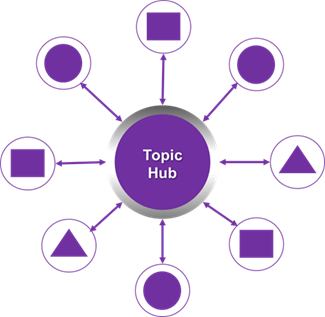
    📷 Topics Hubs Establish Your Topic Authority

    Topic Hubs are focused content centers that concentrate on a specific theme or topic. They act as a go-to source of information on a particular subject and serve as a hub for all related content. These collections of high-quality, relevant content cater to your target audience and communicate your company's proficiency and authority on a particular subject.

    In teaching Topic Hubs using ChatGPT, I have my students first identify the markets for their products and services and then ask ChatGPT the topic categories they find interesting. Next, I have ChatGPT identify the topics related to their company. We then search for the topic categories where the desires of the market intersect with the skills and expertise of the company. Those are the important topics on which to build your topic hub.

    For example, one company I use in my online course on ChatGPT is an energy drink company and they would love to talk about hydration energy drinks all day long. The problem…their audience doesn’t care. The company’s audience is athletes, exercise professionals and active adults. They don’t want to talk hydration but they are extremely interested in topics like

    How does hydration impact my workout? What role does hydration play in my pre-workout routine? What are the best ways to monitor my hydration levels while working out or working in the yard? How does hydration speed up my recovery? And a host of other questions.

    The goal is to develop several Topic Hubs around topics of interest to your target market and, perhaps, one which is more brand focused.

    Why are Topic Hubs crucial for SEO?

    Topic Hubs can make a significant impact on your SEO in several ways. First, they give direction to your content marketing efforts, enabling you to produce targeted, relevant, and high-quality content. This enhances your website's visibility in search engine results, as search engines reward sites that provide valuable and relevant content.

    Second, Topic Hubs help establish your brand as an industry expert. By creating a comprehensive source of information on a particular subject, you showcase your expertise and authority to both your target audience and search engines, thereby boosting your website's credibility. This leads to increased traffic, leads, and conversions.

    Third, each Topic Hub and each one of the topic content articles, videos and podcasts around it will contain four types of keywords. First, there will be keywords associated with the company and key staff. Second, there will be generic terms associated with the topic hub. In the prior example, words like hydration, energy, drink, etc will be used. Third, there will be several keywords associated with the target market like athlete, fitness expert, exercise, etc. Finally, there will be 10+ keywords describing the article itself.

    Lastly, Topic Hubs provide an organized structure for your content, making it easier for users to find what they're looking for. This increases user engagement and reduces bounce rates, both of which are crucial factors in determining your website's ranking in search engine results.

    What is the difference between topic hubs, pillar pages, and cluster content?

    Topic hubs, pillar pages, and cluster content are all terms often used to describe a content strategy focused on improving search engine optimization (SEO) for a website.

    Topic hubs refer to a central page or group of pages on a website that serves as an authoritative resource on a specific topic or set of related topics. The idea behind a topic hub is to create comprehensive, in-depth content that covers all aspects of a particular subject, and then to link related pages or blog posts to that central hub.

    Pillar pages are like topic hubs, but instead of focusing on a single topic, they focus on a broader theme or category that encompasses multiple related topics. The idea behind a pillar page is to provide a comprehensive overview of a broader subject, and to use related topic hubs as supporting content.

    Cluster content refers to a group of related pages or blog posts that are all centered around a specific topic or theme. The idea behind cluster content is to create multiple pieces of content that all support a central theme or topic, with the main pillar page or topic hub serving as the central hub for all the related content.

    These are all terms used to describe a content strategy that focuses on creating high-quality, comprehensive content that is optimized for search engines and designed to attract and engage a targeted audience.

    Steps to Creating Topic Hubs on Your Website

    Identify Your Target Audience and Their Needs: Before you begin creating a Topic Hub, it's crucial to understand your target audience and their needs. Consider their interests, goals, and challenges, and use this information to determine the most relevant and valuable topics and themes. Choose a Focused Topic Category: Once you have a clear understanding of your target audience and their needs, choose a focused topic to create your Topic Hub around. This topic should be relevant to your target audience and align with your company's expertise and goals. Conduct Keyword Research: Before you begin creating content for your topic hub, it is important to conduct keyword research to understand what terms and phrases your target audience is using to find information on your chosen topic. Use keyword research tools such as Google Keyword Planner to identify the most relevant and high-volume keywords, and use these keywords in your content to help improve your search engine ranking. ChatGPT and other AI systems can help identify keywords, topic categories and specific topics to consider. Create a Content Strategy: Once you have identified your keywords, it is time to create a content strategy for your topic hub. Consider the types of content you will create (e.g. blog posts, videos, infographics, etc.), the frequency with which you will publish, and the overall structure of your topic hub. Ensure that your content strategy is aligned with your target audience’s needs, and that it effectively communicates your expertise and authority on your chosen topic. Your goal is to create, publish and then market two content items each month. Create High-Quality, Relevant Content: Once you have created your content strategy, it is time to start creating content for your topic hub. Ensure that your content is high-quality, relevant, and valuable to your target audience. Your content should provide a comprehensive and authoritative source of information on your chosen topic, and should be optimized for search engines using your target market. I like to create 8 – 10 content articles using ChatGPT, publish a couple in the topic hub and place the rest in “inventory” as drafts. I then simply publish one of the draft articles each month to maintain content with my customers and prospects. Link it to the Hub: When you publish an article or video, you want to create some sales copy to place on the Hub. I generally use ChatGPT to read my article and then write sales copy for the Hub. I place the sales copy on the hub with links to the article. I then link the article back to the hub. These links all raise your authority scores with Google and other search engines. Be sure with each publication you have the right keywords and great titles to engage your audience. Market Your New Content: Finally, I use ChatGPT to generate marketing content to inform my target markets that I just published new content. First, I have ChatGPT generate 20 Tweets for Twitter [no X] and some short-form sales copy for LinkedIn and Facebook. I also have it generate some interesting PPC ads for Facebook and Google. The key is to really market your content to create audience awareness. I generally like to have 10 messages PER SOCIAL SITE to really know my messages are getting through. I also email my house list to inform them of my new content offering. The more you market, the more you can penetrate your audience to keep them aware of you and your brand.

    In conclusion, topic hubs can greatly improve your SEO and increase the visibility of your website by providing a comprehensive and authoritative source of information on a specific topic. By focusing on your target audience and their needs, conducting keyword research, creating a content strategy, and producing high-quality, relevant content, you can establish your brand as an expert in your industry, improve user engagement, and ultimately drive more traffic, leads, and conversions.

    Join the ChatGPT Content Revolution Today!

    To join this innovative, proven online course, click HERE to see the course in detail and enroll in the program. The regular cost of the course is $215. But if you enroll before April 1, 2024 and use the promo code “contentintro” at registration, the price will be lowered to $175. Today, digital marketing is accelerating because of these new AI systems. Learn how to apply them to your organization and join the ChatGPT Content Revolution!

    Randy Hlavac

    CEO Marketing Synergy

  • CMOs Beware of Google’s New Page Ranking Algorithm

    Google's new page ranking algorithm

    The digital landscape has grown increasingly competitive over the years and businesses are always looking for great ways to increase their social authority as well as attract more visitors to their site. To maximize our search rankings and improve our SEO, it's crucial to understand the factors that influence your website's visibility. One such crucial factor is Google’s new Double E-A-T – a concept that Google uses to evaluate the quality of content. Modified in December of 2022, it is a major change with direct implications for your digital marketing programs.

    What you don’t know WILL hurt you

    The change in Google’s algorithm in December of 2022 was a direct result of the introduction of ChatGPT one month earlier. Google knew that the release of ChatGPT and similar AI systems would result in a flood of AI-generated blogs, articles, and web pages. These would, in turn, impact search engine results and where your website would rank for the keywords used in these AI-generated articles. And this impact would be substantial.

    The problem they faced was that AI-generated articles don’t really represent who you are. The content doesn’t show your expertise on the topic or the experiences you have had. It also doesn’t adequately show the authority you have developed on the topic. To address these issues, Google changed its algorithm in significant ways.

    Google used the ability of AI systems to read, listen to, and video content placed on your website. In the past, Google would use keyword or tag tables to determine the topics contained in the content. With the new AI’s capabilities, they now process each content item and, by “reading” it, they can determine the keywords associated with the content. As a result, you need to ensure your new and existing content contains all the important keywords.

    Google moves to Double E-A-T

    To determine the “humanness” of your content and ensure its authenticity, Google changed its ranking criteria from E-A-T to Double E-A-T. Double E-A-T stands for Experience, Expertise, Authoritativeness, and Trustworthiness. It is a set of criteria that Google uses to determine the quality of a webpage when deciding how to rank content on its search results pages. It's a crucial element in Google's Quality Rater Guidelines, a guide given to human evaluators to train the Google algorithm to assess the quality and keywords associated with each of your web pages. This, in turn, determines where you will rank in organic search.

    The result is dramatic and is impacting companies today. In discussing the changes in its “core algorithm”, Google’s developers explained “Google's automated ranking systems are designed to present helpful, reliable information that's primarily created to benefit people, not to gain search engine rankings, in the top Search results.” They are looking to see if your content meets the Double E-A-T criteria and is genuinely helping others in a “human” way.

    The result is clear. If you want to optimize SEO, rank high on the keywords you want to develop and establish your topic authority, you need to understand and begin using the Double E-A-T criteria in Google’s new algorithm. To help you, I want to look at each element in Double E-A-T, show you what Google is searching for [in their words], and then provide you some marketing tips to help you maximize your SEO impact and the authenticity of your content.

    Experience

    Experience in the Double EAT system is the extent to which the content creator has the necessary first-hand or life experience for the topic. It is one of the criteria that Google uses to evaluate the quality and trustworthiness of web content. Experience can be demonstrated by:

    1. Provide evidence such as visuals, audio, or other links of your own experience with the product, service, or topic, to support your expertise and reinforce the authenticity of your review.

    2. Provide a narrative with photos that show how you used or interacted with the product, service, or topic, and what benefits or challenges you encountered.

    3. Showing off logos or icons that represent your skills, achievements, certifications, or affiliations related to the topic.

    4. Sharing information with charts or infographics that illustrate your data, insights, or results on the topic.

    5. Using smart typography that highlights your key points, quotes, or testimonials on the topic.

    Demonstrating your experience in your web content can improve your E-E-A-T score and rank higher on Google’s search results page. This can help you attract more traffic, generate more leads, and increase your conversions.

    In my experiences working with non-profits and startups, this criterion is where storytelling is an important skill to have. For every content item you create, you need to relate stories and examples to illustrate key points in the topic. If possible, include a quote from your client about the topic being discussed. The more you can show the audience you have “first-hand” experience with the topic, the stronger your experience score.

    Expertise

    In the Double EAT system, Expertise is the level of knowledge and skill that the content creator has on the topic. It is one of the criteria that Google uses to evaluate the quality and trustworthiness of web content. Expertise can be demonstrated by:

    1. Providing clear and accurate information on the topic, using relevant keywords, headings, and subheadings.

    2. Provide an author biography and byline with your blog post, explaining your qualifications, credentials, and experience on the topic.

    3. Providing helpful, relevant answers to the questions that your audience may have on the topic, providing high-quality content that is well-written, well-structured, well-researched, and well-edited.

    4. Showing that you have done your research by citing expert sources, providing references, and linking to authoritative websites.

    5. Asking for feedback from your audience and updating your content based on their suggestions and comments.

    6. Keeping your content up to date with the latest information and trends on the topic.

    By demonstrating your expertise in your web content, you can improve your E-A-T score and rank higher on Google’s search results page.

    In my Northwestern classes, I discuss the importance of links and backlinks. When you are writing a blog, consider asking one or two experts to provide a quote on your blog. When you add their quote, create 3 backlinks. One to their LinkedIn page or Bio page, one to their company’s website, and one to the article or video they are referencing. In addition, use tools like ChatGPT or Google Keywords to identify the best keywords for EVERY content element you are creating. All of these increase your expertise and, ultimately, your Google search score resulting in more traffic to your site!

    Authoritativeness

    Authoritativeness in the Double EAT system is the reputation and credibility that the content creator, the content itself, and the website have among the relevant audience. It is one of the criteria that Google uses to evaluate the quality and trustworthiness of web content. Authoritativeness can be demonstrated by:

    1. Building authority with lots of original, high-quality pages on a particular topic. The more content you have on a specific topic, the more likely you are to be seen as an expert and a reliable source by Google and your users.

    2. Getting others to refer to you by earning backlinks from authoritative websites. Backlinks are links from other websites that point to your pages. They signal to Google that your content is valuable and trustworthy, and they can boost your rankings and traffic.

    3. Showing official affiliations with recognized organizations, institutions, or entities that are relevant to your topic. For example, you can display logos, badges, certificates, or memberships that prove your credentials and qualifications.

    4. Using Schema markup to add structured data to your pages. Schema markup is a code that helps Google understand what your content is about and displays rich snippets in the search results. Rich snippets can enhance your visibility and click-through rate, and they can also show your authoritativeness by displaying information such as ratings, reviews, awards, or author bios.

    By demonstrating your authoritativeness in your web content, you can improve your E-A-T score and rank higher on Google’s search results page.

    In my experiences, this criterion underscores the importance of developing a network of experts and using them in developing your content. Backlinks to authoritative sources, expert quotes, and getting others to refer to you all enhance your authority scores. You need to be sure your website notes your affiliations and you use these sources where possible to build your authority.

    Trustworthiness

    Trustworthiness in the Double EAT system is the accuracy, honesty, and transparency of the content creator, the content itself, and the website. It is one of the criteria that Google uses to evaluate the quality and trustworthiness of web content. Trustworthiness can be demonstrated by:

    2. Providing a useful set of frequently asked questions (FAQ) and answers.

    3. Providing links to outside sources and materials.

    4. Ensuring the site is frequently linked to by other credible sites.

    5. Disclosing the sources, affiliations, and motives of the content creator, the content itself, and the website.

    6. Protecting user privacy and security by using secure protocols, encryption, and authentication.

    7. Providing information about the website that relates to the context in which it was created and used.

    8. Getting others to refer to you by earning backlinks from authoritative websites.

    9. Using Schema markup to add structured data to your pages.

    By demonstrating your trustworthiness in your web content, you can improve your E-A-T score and rank higher on Google’s search results page. This can help you attract more traffic, generate more leads, and increase your conversions.

    In my Northwestern digital marketing classes, I emphasize the importance of focusing on keywords, structuring your content for easy “consumption” with heading and bullet points, creating internal links using Topic Hubs, using experts for external backlinks, and creating FAQs. This last point is called Help Content in Google’s Hero – Hub – Help strategy that I teach. EVERY one of your content offerings should be developed to add to your company’s authority.

    The New Google Page Ranking Algorithm in Action

    Let's take an example to understand how E-A-T can influence your website's rankings.

    Imagine you run a fitness blog, providing tips and guides on workout routines. Your content, while useful, is created based on your personal experiences and knowledge acquired from various sources. Now, consider a competing blog run by a certified fitness trainer who uses their professional knowledge and experience to create content.

    According to Google's E-A-T guidelines, the fitness trainer's blog has more expertise, experience, and authoritativeness, and therefore, it's likely to rank higher in search results for fitness-related queries.

    Implementing Double E-A-T in Your Strategy

    Understanding Double E-A-T is one thing, but how do you incorporate it into your SEO strategy? Here are three actionable steps to get you started:

    Demonstrate your Experience – Your target audiences want to know you have the skills and experiences to help them succeed. Show them examples and relevant stories. It makes your skills real and believable. Show Your Expertise: Highlight your qualifications, certifications, and experience related to your field. Add a bio to each blog post showcasing your credentials. If you're not an expert, consider hiring or collaborating with experts to create content. Build Your Authoritativeness: Create high-quality, accurate content consistently. Encourage other authoritative websites to link to your content. Guest posting, social media engagement, and collaborations can help you achieve this. Establish Trust: Ensure your website is secure (HTTPS) and user-friendly. Have clear and easily accessible privacy policies and disclaimers. Make sure any claims you make are substantiated and be transparent about your business and content creators.

    Conclusion

    In an era where information is abundant, the E-E-A-T principle serves as a guideline for providing reliable, trustworthy, and high-quality information to users. By understanding and implementing E-E-A-T in your SEO strategy, you're not just improving your chances of ranking better on Google; you're also enhancing the overall credibility of your brand.

    Join the ChatGPT Content Revolution Today!

    To join this innovative, proven online course, click HERE to see the course in detail and enroll in the program. The regular cost of the course is $215. But if you enroll before April 1, 2024 and use the promo code “contentintro” at registration, the price will be lowered to $175. Today, digital marketing is accelerating because of these new AI systems. Learn how to apply them to your organization and join the ChatGPT Content Revolution!

    Randy Hlavac

    CEO Marketing Synergy

  • Destroying the Content Bottleneck! chat gpt for content creation

    Destroying the Content Bottleneck

    When it comes to creating multimedia content and the marketing and advertising messages to promote it, you quickly discover the content bottleneck. You realize you need more and more content to engage customers and prospects but you have too few people, limited resources, little time to train your staff, and no time to generate the content you need to succeed. As a result generating new, highly targeted content and marketing messages falls to the bottom of your “To Do” list and, often, never gets done.

    2 New Technologies Changed Marketing Forever

    In 2022, two new technologies changed marketing forever. In November of 2022, OpenAI introduced ChatGPT. If you know how to train and use it, ChatGPT can play a pivotal role in overcoming the content bottleneck by enhancing content creation, ideation, marketing, and PPC advertising processes. What used to take days or weeks, now takes minutes or hours.

    In response to the threat of AI-generated content flooding websites, Google introduced its new Page Ranking algorithm in December of 2022. The new algorithm now scans your web pages to separate AI from “human” content and lowers your ranking if there is to much AI. As a result, you need to take the output from ChatGPT and use Google’s Double E-A-T system to establish your Experience, Expertise, Authority, and Trustworthiness. It makes the content both human and displays your authority to maximize each page’s SEO power.

    Introducing the ChatGPT Content Revolution Online Course

    Since 2022, I have been incorporating ChatGPT and the new Google algorithm into my Digital Marketing and Content Strategy classes at Northwestern. My students form teams and work with actual clients to build their Content Strategies. They build a holistic, multimedia 52-week plan designed to grow market share, gain competitive advantage, build strong long-term prospect and customer relationships, and develop marketing materials & PPC ads to drive business to the organization’s website. We work with non-profit and for-profit organizations from startups to Fortune 50 companies.

    I have incorporated my experience into a new online course called “The ChatGPT Content Revolution”. In this new online course, you will learn to:

    1. Train ChatGPT to be your business partner

    2. Identify the markets most attracted to your organization

    3. Develop Topic Clusters and Multimedia Content designed to attract the markets you want to attract and engage

    4. Create multimedia content including blogs, web pages, podcasts, and video scripts

    5. Test and edit your content to pass AI Detectors

    6. Use the Google algorithm to establish your topic authority and maximize your SEO impact

    7. Generate marketing messages and PPC ads to attract your target audience to your new content

    8. Create a 52-week content schedule and learn how to use schedulers to automate the marketing process

    This course is designed for all marketers and content creators and takes 2-3 weeks to complete. It has 40+ short 7-minute videos to teach key concepts, prompt scripts so you can tailor ChatGPT for your organization, templates designed to create your 52-week calendar, and other aids to build your content and marketing programs. I will be active on discussion boards, hosting live chats, and answering emails to ensure you will be successful in the course. And, at the end, you will receive a Certificate of Completion.

    Join the ChatGPT Content Revolution Today!

    To join this innovative, proven online course, click HERE to see the course in detail and enroll in the program. The regular cost of the course is $195. But if you enroll before April 1, 2024 and use the promo code “content_revolution” at registration, the price will be lowered to $95! Over a 50% savings if you act now!. Today, digital marketing is accelerating because of these new AI systems. Learn how to apply them to your organization and join the ChatGPT Content Revolution!

    Randy Hlavac

    CEO Marketing Synergy